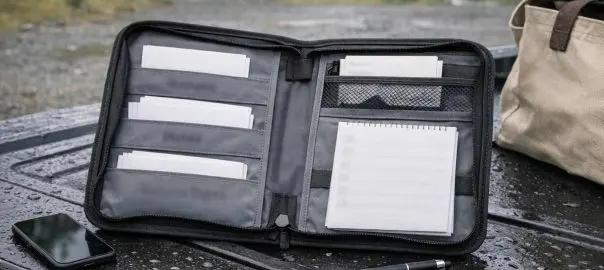
Reception and Organization of Gun Show Purchases and Correspondence: After returning from a gun show, organizing the numerous receipts, correspondence, advertisements, and confirmation orders received during the show can be an arduous task. If there is sufficient time to sort out the necessary documents after returning home, organizing them in a folder as soon as possible will help organize the necessary information for future reference regarding items that were purchased, their costs, etc. Organizing documents after a gun show can be as simple as a folder and can also include more complex organizational methods using a computer such as a spreadsheet.
The Importance of Quick Sorting
After the gun show, it is relatively easy to sort all your papers in a few hours. While at home, simply sort all papers and receipt-like items into 3 stacks of papers: Items for Records (receipts, invoices, etc.), Items for Reference (vendor cards, manuals, warranty information, etc.), and Items for Follow-up (questions concerning discrepancies or unknown information). Take note of items in the Follow-up stack as soon as possible.
Waiting a few days to try to remember the small details of your show can prove difficult and lead to errors. Write down all of the show's information within a few hours of its end: the dates of the show, the names of all of the shooters and retailers, and write down as many details as possible about the many guns that you purchased. Note any unclear points on the receipts that may have been written too poorly to read. It is easy to mistakenly put the wrong documents in the wrong stacks of papers, and once you have sorted through all of your documents, recalling forgotten details can be time-consuming.
Deciding Which Records to Keep
Receiving confirmation that minor items have received were received is obviously not worth the storage of the receipt. However, if the items received were firearms or other equipment of high value, then there is a greater amount of information that needs to be tracked. This would include a description of the item, the date and location of the purchase, the price at which it was purchased, as well as any services, such as maintenance, and warranties or transfer papers that were also received.
Transactions involving firearms require special recording, including all documentation given to you by the seller. Remember that laws covering these kinds of transactions are issued by individual states, can be applied differently based on the type of transaction, and can change over time. So the way you keep records for these types of purchases will help you to comply with all applicable laws and practice safe and responsible gun ownership; however, these records should not be considered a substitute for contacting the appropriate authorities or firearms experts as necessary.
Be sure to consider the virtues and pitfalls of keeping gun show documents as paper or as digital information. Paper gun show documents are easily accessible by all household members and do not require any connection to the internet to be searched for later. However, digital versions allow for search functionality as well as copies to be made of critical documents. This mode of information though possesses many security considerations that must be taken into account as well. Do not keep sensitive information in unsecured locations, nor in shared folders that can contain information that would be detrimental to others should they access it.
Creating Your Custom Organization System
For casual gun show attendees, a simple organization system to store their paperwork after the event would likely consist of several sections within a folder to store receipts, vendor provided documentation, parts and accessories maintenance records, and items requiring follow up action.
For regular gun show attendees, a more complex organization system can be the ideal solution to managing a substantial amount of paperwork. Be sure to include purchase dates, sellers' names, the model and type of guns purchased, the location in which the receipts were left, the amount of money spent, and any notes regarding accessories for specific items in your organized notes. When naming your digital files, use the exact same information from your receipts and verify the model and/or type of gun against the corresponding physical item whenever possible.
Storing original paper documents in a safe place along with high quality copies of those same documents on your computer is the best of both worlds. Choose a filename for your digital document that includes the date of purchase and the name of the vendor who sold you the firearm or related item. Instead of making up a useless filename like "New Shotgun," use "20090525_HoltDifference."
Verifying Purchases Against Receipts
Link the paper documents that you have sorted in the first step to the corresponding physical objects. Compare the written documentation on a receipt with the description of the corresponding item in your inventory. Also check for the correct quantity of items with accessories or for additional notes on the receipt such as services, warranties or special conditions. Discrepancies that have arisen as a result of your comparison with the original documentation (e.g. receipts that have become partially faded over time) must be immediately recorded and confirmed with the seller. For the sake of clarity, distinguish between the documentation of the ownership of a product and the logistical documentation.
Use this process to distinguish between your ownership records and your other logistical notes. Your purchase log will contain a record of what you purchased at a given time. Your household inventory will contain pictures of your guns, information on how you are insured against loss, where you store your guns, etc. Be very sure that this type of sensitive information is kept safe from others.
Do not forget that for firearm transactions, documentation for registration or transfer of ownership may be required and so you should seek out current requirements from relevant authorities and note that a simple receipt may not be sufficient to cover all administrative or legal tasks for a transaction.
Expanding Your Budgeting Considerations
First, you must factor in all of the costs to go to a gun show in your initial budget and track all of the other expenses you incur while at the show. Costs like gas, gun safes, cleaning solutions and clothing, shooting lessons, repair parts and service for your firearms and accessories as well as documentation and storage at home. Document your additional expenses at the gun show to see if that item you thought you got away cheaply really was after all.
When you get home after a gun show list out the total expenditures and compare them to your initial budget for the gun show. If the two numbers are not close list out reasons for large differences. Some reasons for large differences could be items that were purchased on the impulse, items that had extra features that were not in your budget, items that had obscure return policies, items that had to be replaced because you did not adequately research the item before purchasing it.
Records of your spending can then also serve as future proof to see which expenses where planned, which were opportune and which you have to postpone. This can also help you to evaluate if you took enough time to think through a purchase or if you could have done better.
Avoiding Common Recordkeeping Mistakes
A big mistake with organizing purchases is to wait too long to start. In the intervening time receipts may fade, digital documents get lost in a massive, unorganized data store, and your memory of details like the vendor's name for that particular model of flashlight may fail. The biggest mistake of all is to keep only proof of payment for a purchase (e.g. a receipt) and discard the rest of the seller's documents and terms.
Consider avoiding a general category for the paperwork from gun shows. Though this may seem the easiest of all the categories, it can actually make retrieval of important warranties and transaction documents more difficult than if they were assigned to their own specific folders. Share photos of your receipts and other documentation from gun shows with caution and avoid posting any sensitive information on social media accounts associated with your profile online.
The final step of record management is periodic review of the established organization structure. Look for duplicates in your stored documents, review your current backup for stored information, clarify unclear notes, and take suitable measures to safeguard sensitive information. Don't confuse the task of establishing a large and complex archive with creating an adequate record management system to support proper budgeting, verify ownership, and make informed purchasing decisions.